NanoPi R76S vs Raspberry Pi 5: Which Board for Networking and AI?
NanoPi R76S against Raspberry Pi 5: processor, memory, network ports, AI chip and software support, and which board fits a router or a first project.
3 min readBy Smita
Outgrown a small board? A dedicated server gives you server-class processors, memory and a datacentre connection. See Cheap Dedicated Servers from $38.99
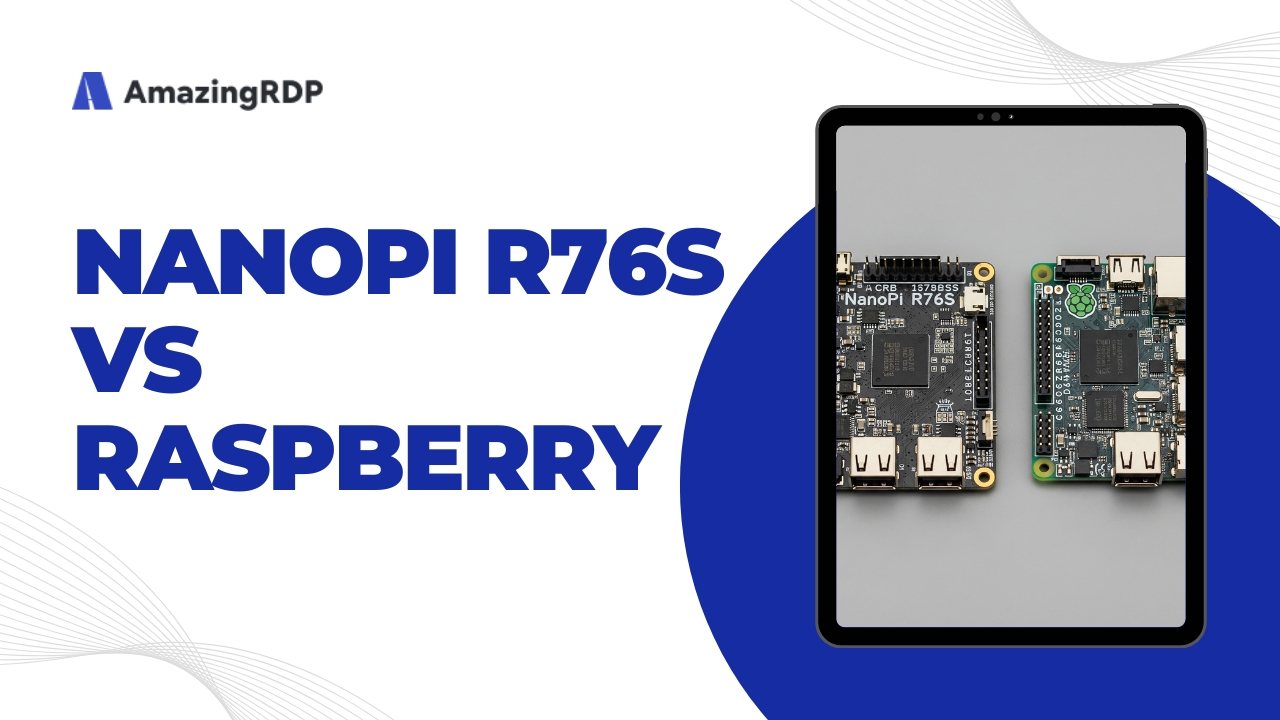
The Raspberry Pi 5 is the default single-board computer: well documented, supported everywhere, good at nearly everything. The NanoPi R76S from FriendlyElec is a specialist. It is built as a small router and gateway, with two fast network ports and a chip for AI tasks. Which one you should buy depends on the job.
The two boards side by side
| NanoPi R76S | Raspberry Pi 5 | |
|---|---|---|
| Processor | Rockchip RK3576: 4 Cortex-A72 + 4 Cortex-A53 cores | Broadcom BCM2712: 4 Cortex-A76 cores |
| Memory | Up to 16 GB | Up to 16 GB |
| Wired network | Two 2.5-gigabit ports | One 1-gigabit port |
| AI chip (NPU) | Built in, rated at 6 TOPS | None on the board; added with an AI HAT |
| Built-in storage | eMMC on the board, plus microSD | microSD; NVMe SSD through an add-on board |
| Wireless | Added through a module slot | Wi-Fi and Bluetooth built in |
| Add-on pins | Few | 40-pin header with a huge range of add-on boards |
| Main systems | FriendlyWrt (OpenWrt), Debian, Ubuntu, Android | Raspberry Pi OS, Ubuntu, and most others |
Check the makers' pages for current prices and for the memory sizes on sale.
Processor: more cores against faster cores
The NanoPi has eight cores, the Pi four. The Pi's four are a newer and faster design, so it is quicker at tasks that use one or a few cores, which is most desktop and scripting work. The NanoPi's eight older cores suit many small jobs at once, such as routing plus a few containers.
Networking: the NanoPi's reason to exist
Two 2.5-gigabit ports make the R76S a ready-made router or firewall: one port to the internet, one to your network, with FriendlyWrt already set up for that. The Pi 5 has one gigabit port; a second needs a USB adapter. For a home router, a VPN gateway or a traffic filter on a fast line, the NanoPi is the simpler build.
AI: built in against add-on
The R76S has a neural processing unit on the chip, useful for small vision models such as detecting people in a camera picture. Models must be converted with Rockchip's tools first, which takes some patience. The Pi 5 has no such unit, but its official AI HAT adds a stronger one, with better guides. Neither board trains models or runs large language models at a useful speed; that work belongs on a graphics card.
Software and community: the Pi's lead
This is the Pi's biggest advantage. Almost every guide, add-on board and project is written for it, updates arrive for years, and help is one search away. Rockchip boards depend on the maker's own system images, and support in standard Linux arrives later. If this is your first board, that difference matters more than any number in the table.
Which one to buy
- Router, firewall, VPN gateway: NanoPi R76S.
- Small always-on box for a few containers on a fast home network: NanoPi R76S.
- Learning, electronics projects, a small desktop, a media player: Raspberry Pi 5.
- Home automation: Raspberry Pi 5, because the software is made for it. (For a much smaller board, see Home Assistant on a Pi Zero 2 W.)
- Camera AI at the edge: either; the Pi with an AI HAT is easier to get going.
Where a small board stops
Both boards live on your home connection and a small power supply. A public website, a database with real users, model training or anything that must stay reachable when your home line is down belongs in a datacentre: see our dedicated servers and GPU dedicated servers. A common split is to keep the board at home for local tasks and rent the heavy machine. Related: 2025's fastest server CPUs.
Questions
Is the NanoPi R76S faster than the Raspberry Pi 5?
Not per core. The Pi 5's four cores are a newer, faster design. The NanoPi has eight older cores, which helps with many small tasks at once.
Which board is better as a router?
The NanoPi R76S. It has two 2.5-gigabit network ports and ships with an OpenWrt-based system.
Does the Raspberry Pi 5 have an AI chip?
Not on the board. An official AI HAT adds one.
How much memory can each board have?
Both are sold in versions up to 16 GB.